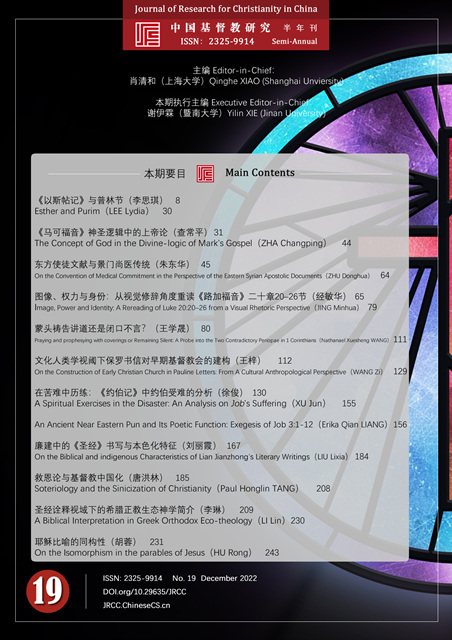
An Ancient Near Eastern Pun and Its Poetic Function: Exegesis of Job 3:1-12
DOI:
https://doi.org/10.29635/JRCC.202212_(19).0008关键词:
Job 3:1-12, Old Testament, Wisdom Literature, biblical poetry, translations, phonetic, poetic intensification摘要
The story of Job is part of a larger ancient tradition. Situating the possible translations of Job 3:8 within the Ancient Near Eastern context, this essay focuses on how the poetic language functions in Job 3:1-12. I suggest that both renditions of “day” and “sea,” albeit the difference, are faithful in their approaches to the original text. the rendition of “sea” echoes the primary meaning found in other ancient texts. Translating yom as “day” has a three-fold significance: it preserves the recurring words’ linguistic equivalence in the source text[1] and coheres with the structure of intensification, underscoring the author’s desire to strengthen the power of the curse.[2] The use of the Aramaic pronunciation cre-ates the pun as it expresses the secondary meaning, “day,” which also seeks to intensify the curse.[3] We note that “sea” associated with the sea god, Yamm, and Leviathan, echo several Ancient Near Eastern motifs, especially the curses found in their literary traditions and those found on incantation bowls.
[1] Robert Alter, The Art of Biblical Poetry (version New and rev. ed.). (New York: Basic Books, 2011). p. 95.
[2] Ibid., p. 655.
[3] Greenstein, “The Language of Job and Its Poetic Function.” Journal of Biblical Literature 122, no. 4 (Wint 2003), p. 654.
##submission.downloads##
已出版
期次
栏目
##submission.license##
##submission.copyrightStatement##
##submission.license.cc.by-nc-nd4.footer##